Stories, History, and the Impact of the World War on Jews in Hungary
"A quiet voice from the Danube banks, when Budapest remembers the past with its heart"
Rin takes you back through the memories of Jews in Hungary
Sometimes, the beauty of a city may not lie only in castles, towers, or high-angle views from the river, but is hidden in the traces of what once happened and in the hearts of people who refuse to let the stories be forgotten.
In Budapest, the capital of Hungary, besides the classic Central European beauty, there is another chapter—a chapter that is quiet, sorrowful, and full of historical scars. That is the story of Hungarian Jews during World War 2.
Rin would like to take all fellow travelers through the old Jewish Quarter, learn stories that some of you may never have heard, and introduce real places that still remind us that “the past never disappears if we still listen to it with our hearts.”
The impact of World War II on the Jewish people in Hungary is one of the most brutal and heartbreaking chapters in Hungarian national history and for Central European Jews, especially in 1944, which was the year the largest number of Hungarian Jews were sent to concentration camps in the history of the Holocaust.
Background of Jewish People in Hungary before the World War
Before World War II, as many as approximately 825,000 Jewish people lived in Hungary (accounting for ~6% of the population).
They were an integral part of Hungarian society:
- Working in academia, medicine, the arts, and business
- Living alongside Hungarians in urban communities such as Budapest, Debrecen, and Szeged
- However, during the 1930s, anti-Jewish laws (Jewish Laws) began to be enacted, such as restricting rights to employment, civil service, or higher education
When World War II Began
- Hungary joined the Axis Powers (Germany, Italy, and Japan)
- Although the Hungarian government initially tried not to send Jews to concentration camps, there was oppression and forced conscription of Jews into military labor service, where many died in large numbers
The 1944 Turning Point: Occupation by Nazi Germany
- March 1944: The Nazi German army invaded and occupied Hungary out of fear that Hungary would withdraw from the war
- A far-right puppet government (Arrow Cross Party) took power, supported by Nazi Germany
- Between May and July 1944, more than 437,000 Jews (mostly from outside Budapest) were arrested and deported to Auschwitz-Birkenau in just 56 days
- 90% of those deported were immediately murdered in the gas chambers
Atrocities in Budapest
- Late 1944 – early 1945: Approximately 200,000 Jews remained in Budapest
- The authoritarian regime (Arrow Cross Party) brutally murdered Jews in the city
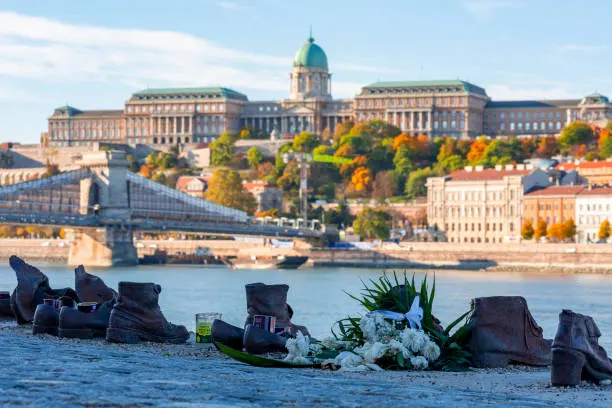
- Jews were rounded up, shot along the banks of the Danube River, and their bodies thrown into the water—today, the “Shoes on the Danube Bank” memorial features cast iron shoes in their remembrance
- Some survivors hid in safe houses and certain embassies, such as:
- The safe houses of Raoul Wallenberg, a Swedish diplomat
- Carl Lutz, a Swiss diplomat, and Angelo Rotta, the Vatican papal nuncio, who issued protective documents saving many Jewish lives
The Resulting Impact
- Before the war: ~825,000 Jews in Hungary
- After the war: Fewer than 255,000 survived
- Approximately 600,000 people were murdered during the Holocaust
- Hungary became the country where the largest number of Jews were murdered in the shortest period of time
Memorable Stories
Raoul Wallenberg
- A Swedish diplomat who helped issue “Schutzpass” (protective documents) to Jews
- Saved more than 10,000 Jewish lives before disappearing after being arrested by the Soviets
Shoes on the Danube Bank
- A memorial in the form of "iron shoes" lined up along the riverbank representing the victims who were shot and thrown into the water deeply moving and a symbol of remembrance in silence
Relevant places to visit in Budapest
- Dohany Street Synagogue & Hungarian Jewish Museum
- Raoul Wallenberg Memorial Park
- Holocaust Memorial Center
- Shoes on the Danube Bank
- Rumbach Street Synagogue (exhibiting stories of the Jewish community and survival)
Budapest... is a lesson in humanity
World War 2 left deep scars on the hearts of as many as 600,000 Hungarian Jews, and the city of Budapest itself chose not to erase this, but instead embraced it with courage—not for sadness, but to remind the world never to repeat the past.
Every riverbank, every alley in the Jewish Quarter, and every name in the museum is a whisper from the past that still wants us to know that kindness, courage, and humanity never lose their meaning.
Rin invites everyone to journey not only with your feet, but with your heart, opening up to the stories of the Jewish people in Hungary. You may find that deeply understanding the past is one of the most transformative journeys we can ever take.
Planning it yourself?
What independent travellers usually book before they go, from providers that actually work

Thai language, pay in baht
 Photo: Bahnfrend · CC BY-SA 4.0 · Wikimedia Commons
Compare many rental companies on one page
Popular with Thai travellers, Thai-language pages
 Photo: Perituss · CC0 · Wikimedia Commons
Hotels near the station and old town, many with free cancellation
Partner links · we may earn a small commission when you book, your price stays the same
Let Rin design a trip for your group